
Author: Nanaimo Moss Removal
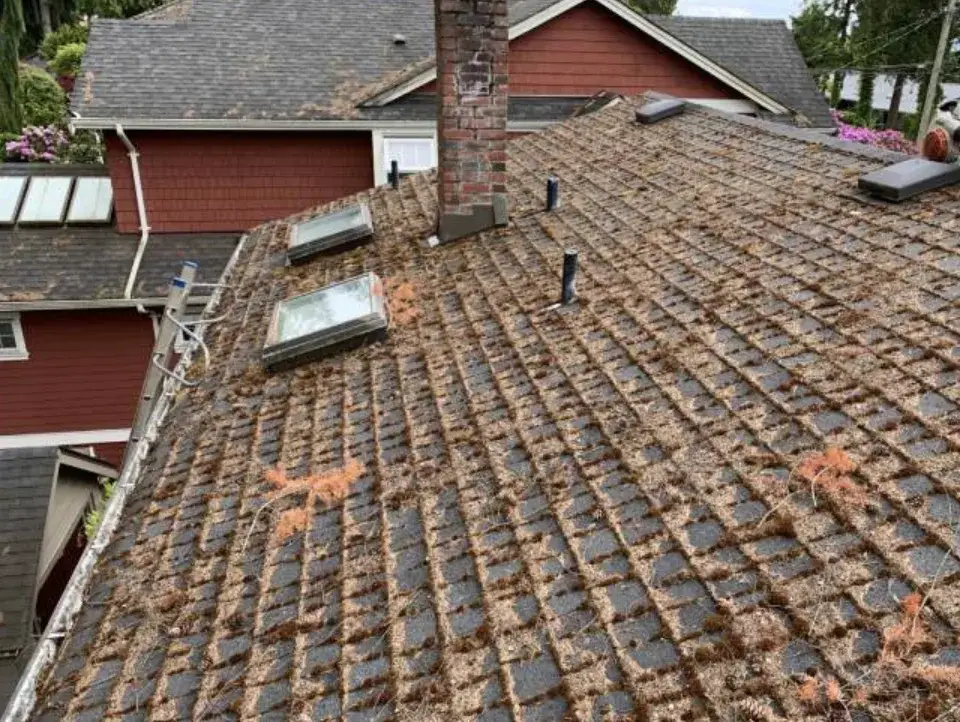
Moss on roof shingles is easy to spot and hard to judge. A green fringe along the lower courses might be a few seasons of harmless growth, or it might be the visible part of a problem that has been working under the tabs since the last wet winter. Most Nanaimo homeowners never climb up to find out, and they should not have to. This guide is about reading the evidence you can see from the yard, the driveway and the bottom of your downspouts, so you know whether you are looking at a cleaning job, something to watch, or a roof that is ready for a roofer.
First, why this matters more on mid-Island roofs
Nanaimo gets most of its rain between October and March, and the summers are comparatively dry. That pattern suits moss well. It sits dormant and brown through August, then greens up and spreads through the long damp months when nothing on a shaded roof dries out for weeks at a time.
The setting adds to it. Plenty of homes in Harewood, around Departure Bay and up the slopes above the harbour sit under mature Douglas fir and cedar, and in Lantzville and the acreages around Cedar the tree cover is often heavier still. Needles land on the roof, collect in the valleys and behind chimneys, and hold water against the shingles. Moss takes hold in exactly those spots first.
None of that means every mossy roof is in trouble. It means the signs below show up sooner here than on an open lot in a drier climate, so they are worth knowing.
Start at the bottom of the downspout
The most useful diagnostic tool on a shingle roof is the splash pad at the foot of your downspout. Asphalt shingles are coated in small mineral granules that shield the asphalt from sunlight. When those granules come loose, the rain carries them into the eavestrough and out the bottom of the downspout, where they pile up as dark, sandy grit.
Some grit is normal and not a worry. IKO, a Canadian shingle maker, explains that new bundles carry extra loose granules from the factory, that these wash off over the first few years, and that losing them does not shorten the shingles’ weatherproofing life. The same bulletin draws the line clearly: granule loss starts to matter when patches of bare asphalt are showing on the shingle surface.
So the question to ask is not “is there grit?” but “how much, and how old is the roof?”
- A light sprinkle on a roof under five or so years old is usually the factory surplus coming off.
- A steady layer every time you clear the gutters on an older roof points to the shingles themselves wearing.
- Grit mixed with clumps of green or brown moss tells you the moss is holding on to granules as it grows and taking them with it when it falls.
If you clear your own eavestroughs, look at what comes out before it goes in the bag. A trough that is half sand is telling you something about the roof above it.
Look along the edges of each course
Stand back far enough to see the roof at an angle, ideally in low morning or evening light that throws shadows. A healthy shingle course is a series of straight, flat lines. Moss changes that in two ways you can see from the ground.
Raised tabs. As a moss cushion thickens under the bottom edge of a tab, it pries that edge upward. From the lawn this reads as a ragged or wavy shadow line where it should be crisp. A tab that has lifted has usually lost its seal to the course below, and an unsealed tab is the one a winter southeaster is most likely to catch.
Curling or cupping. Edges that turn up at the corners, or tabs that look dished in the middle, are more often a sign of age and heat than of moss alone. Moss makes it worse by keeping the curled area wet, but curling on its own usually means the shingles are well into their working life.
Raised tabs on a roof that is otherwise in fair shape are one of the clearest reasons to deal with moss now rather than next year. Curling across a whole slope is a different conversation, and it belongs in the section on roofs that are past cleaning.
Dark wet patches and bald spots
After a dry spell, most of a shingle roof dries within a day or two of rain. Watch for areas that stay dark long after the rest has gone back to grey. Those damp shadows mark where moss and trapped needles are holding water, and they usually line up with the north-facing slope, the valleys and the strip behind a chimney.
Oregon State University Extension makes a point that helps here: moss is not chewing through the roof. What it does is trap soil and debris that keep the surface wet, and that steady moisture invites fungi and speeds decomposition of the roofing. A patch that never dries is where that slow damage happens.
Bare spots are the more serious sign. If you can see shiny or black areas where the coloured granule surface is gone, or a shingle that looks smooth and flat compared with its neighbours, the asphalt underneath is exposed to the sun. Binoculars from the driveway are enough to pick these out. One or two small spots can be watched. Many of them, spread across a slope, mean the shingles are near the end.
Streaks, film and cushions: what is cosmetic and what is not
Not everything on a roof that looks like a problem is one. It helps to sort what you see into three groups.
Black or dark grey streaks running down the slope are almost always algae, a type that feeds on the limestone filler in many shingles. The streaks look grubby, and they can make a roof read as older than it is, but the roofing industry’s position is that this algae is a looks problem rather than a structural one. It does not lift tabs or hold water the way moss does.
Pale crusty rosettes are lichen. They grip tightly and grow slowly. Lichen is worth treating along with moss, but it does not build the thick, water-holding mats that cause most of the trouble.
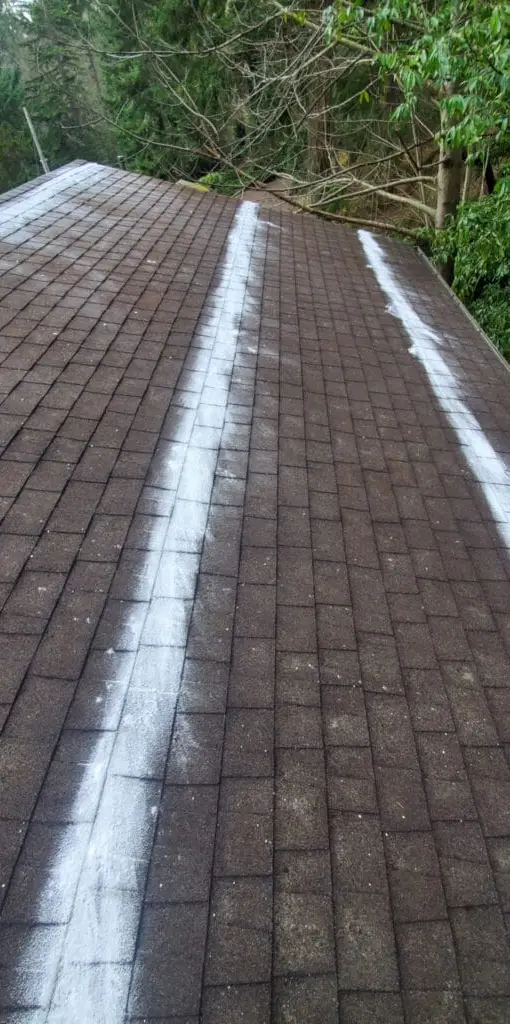
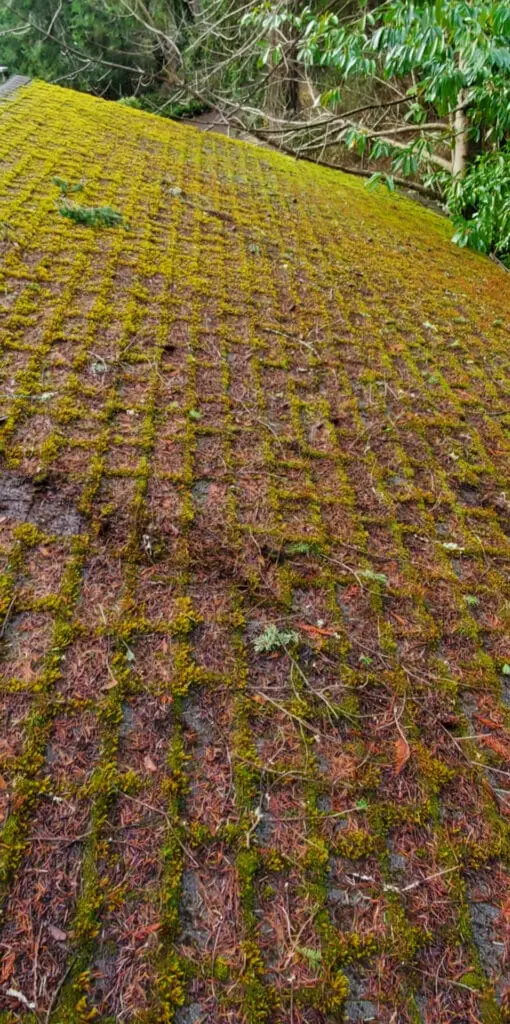
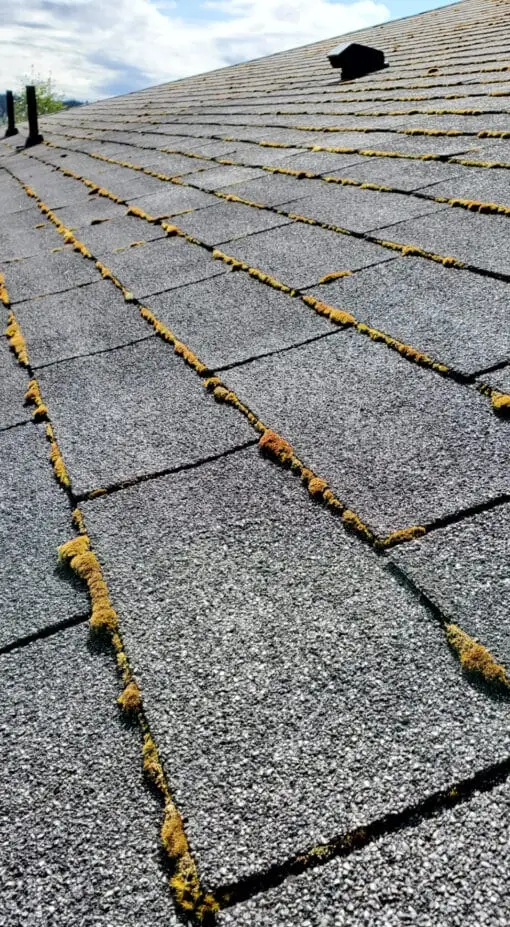
Raised green cushions, fuzzy lines along the courses and moss packed into the valleys are the ones that matter. These hold rain like a sponge, collect needles, push up tab edges and catch granules. If your roof has these, it is past the purely cosmetic stage, even if nothing is leaking yet.
A roof with only streaks can wait for whenever the look bothers you. A roof with cushions should be on a list.
When a roof is past the point of cleaning
Moss treatment is a good investment on shingles that still have useful life in them. It is not a repair, and on some roofs the honest answer is that the money is better spent on new shingles. From the ground, these are the signs that point that way:
- Bare asphalt showing in many places across more than one slope.
- Curling or cupping across most of a slope rather than a few isolated tabs.
- Missing tabs, or tabs that have cracked straight across.
- Stains on the ceiling or in the attic, or daylight visible through the roof boards from inside.
- A roof that is already well past the life its shingle type was rated for when it went on.
If several of these apply, we will tell you so plainly at the quote. Treating the moss on a roof that needs replacing only delays a decision you will have to make anyway, and a roofer is the right person to look at the deck and the underlayment. If you are planning a new roof within a year or two, it is usually not worth paying for moss removal first.
Where the shingles are sound and the problems are moss-driven, such as a few raised tabs, damp valleys and a band of cushions along the lower courses, the roof is a good candidate for treatment.
Where a soft wash fits once you know what you are looking at
On a shingle roof that is worth keeping, our approach is a low-pressure soft wash that carries the moss treatment. The treatment is included in the job, not sold as an extra, and nothing on the roof is blasted at high pressure. The wash is set for the slope, the shade and how heavy the growth is, and it soaks into the cushions rather than trying to strip them.
The moss does not vanish while we are there. Over the following weeks it dies, turns brown and lets go, and Nanaimo’s rain carries it off the roof. Raised tabs can settle back a little once the cushion underneath is gone, though a tab that has lost its seal will stay a weak point. Afterward we check and clear the gutters, since dead moss and loose grit end up there.
Our asphalt shingle roofs page goes further into how we treat this roofing type, and the roof moss treatment guide compares treatment with zinc strips and the other options people ask about. If you are deciding when to book, our timing guide covers the season.
Moss can grow back, particularly on shaded slopes under heavy needle fall. Trimming branches that overhang the roof and keeping the valleys and eavestroughs clear does more to slow it than anything else, and our prevention page lists the practical steps.
What a treatment costs on a Nanaimo shingle roof
Roof moss removal starts at $495. On a roof of about 2,000 sq ft, a light growth runs about $600 and heavy cushions about $1,000. Size, pitch, access and how much moss is up there move the figure, and every quote is free and set before any work starts. The cost breakdown explains each factor.
If the grit test sent you to your gutters and you would rather not clear them yourself, gutter cleaning starts at $165. Booking it with roof moss removal on one visit qualifies for our package pricing.
Questions people ask after looking up at their roof
Can I tell if moss has caused a leak without going in the attic?
Not reliably. Ceiling stains are a late sign. A look in the attic with a flashlight after a few days of heavy rain, checking the underside of the roof boards for dark or damp areas, tells you far more than the outside can.
Is it safe to walk on a mossy shingle roof to check it?
We would not recommend it. Wet moss is slippery, and every step on worn shingles knocks off more granules. Binoculars from the ground show most of what you need.
My neighbour’s roof has streaks but mine has cushions. Why the difference?
Usually shade. Streaks show up on sunny slopes where moss struggles, while cushions grow where trees keep a roof cool and wet. Two houses on one street in Departure Bay can look completely different for that reason alone.
Will treating the moss fix my lifted tabs?
Removing the cushion takes away what was pushing them up, and many settle somewhat. A tab that has lost its adhesive bond may need a roofer to reseal it.
Get a second opinion on what you are seeing
If you have read the signs and are still not sure which group your roof falls into, send us a photo from the yard along with your address. We work across Nanaimo, Lantzville and Cedar, and up and down the coast from Ladysmith to Qualicum Beach. Nanaimo Moss Removal has been treating roofs here since 2021. Phone (778) 762-3475, send a text, or fill in the quote form and tell us what you noticed in the downspout.
These figures are a guide, not a quote. The size and steepness of the roof, what it is made of, how we reach it and how heavy the moss is all change the price, so every job gets its own free written quote once we have seen the roof.
A starting price, not a flat rate. How tall the house is, how many metres of gutter it has, where a ladder can stand and how packed the troughs are decide the real number, and you get that number in writing, free, before any date is set.