
Cedar shake
Cedar Shake Roof Moss Removal in Nanaimo
Cedar soaks up water, softens and splits, and moss speeds all of that up. We clear shake roofs slowly by hand, along the grain, and tell you which shakes have gone soft.
Customer reviews
What customers say
Amazing! Sent in a request form on their website in the morning, heard back that afternoon, and booked for the next day. Very fast, reliable, and efficient.
They are efficient, hardworking, and reliable. I’ll definitely call them again for other services. Highly recommended!
Great customer service, and they came quickly..will be using again for sure
Why us
Why customers love our service
And why you will get the best moss removal service in Nanaimo!
Fast and efficient moss removal
We turn up on the day we said, clear the whole roof, and get off your property without stretching the job out.
Clear and quick communication
You get an answer when you call or text, a price before we start, and a straight account of what we found up on the roof.
Five-star reviews
Consistent five-star reviews from the homeowners our crew works for.
Clearing moss since 2021
Asphalt shingle, cedar shake, tile and metal roofs, and the driveways and paths below them.
- A slope-by-slope look at the shakes before anyone steps on them
- Keyways between shakes cleared by hand, top to bottom
- Moss brushed off the faces with the grain, never against it
- Hips, ridges and valleys cleared of packed moss and needles
- Treatment applied to the growth left in the wood surface
- A list of soft, split, cupped or missing shakes, with photos
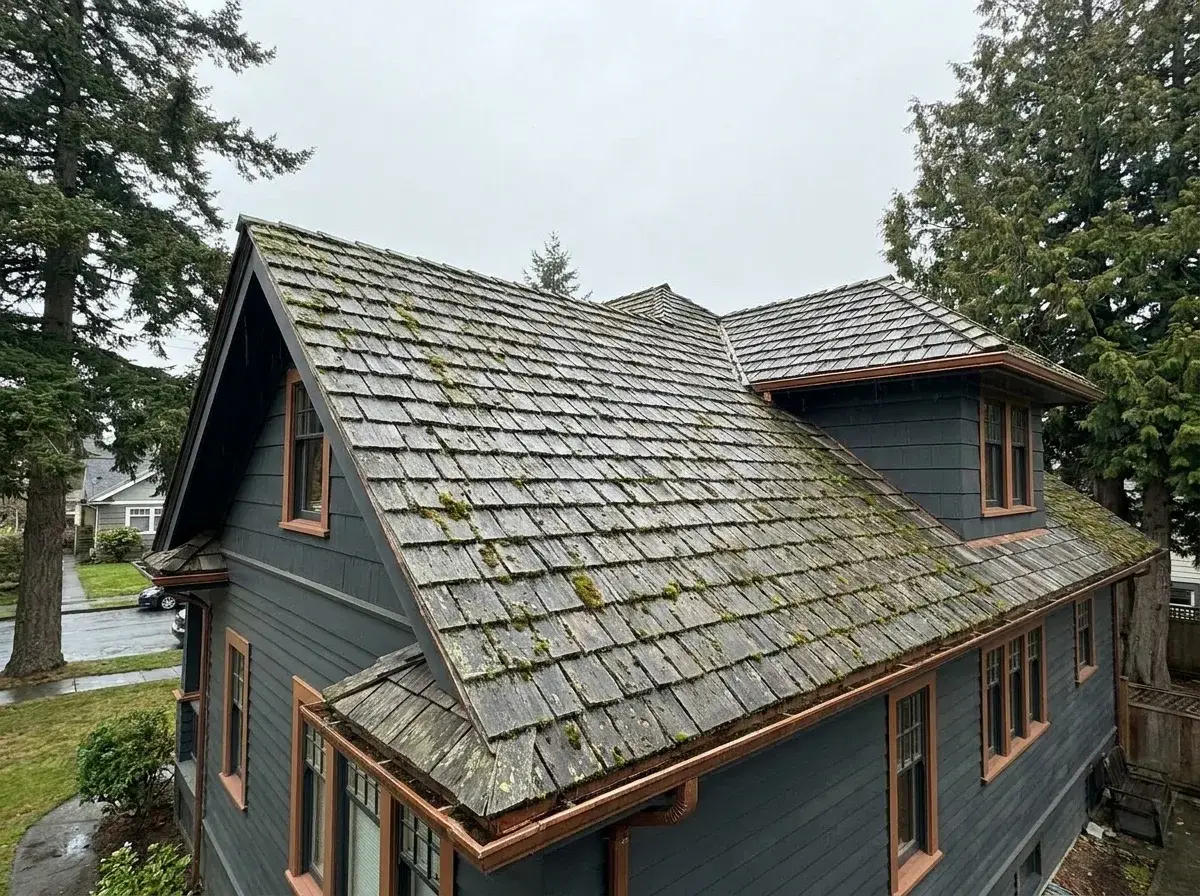
Cedar shake roofs are still common on Nanaimo houses built in the 1970s and 1980s, especially on the wooded lots around Hammond Bay, Uplands and out through Nanoose Bay. They look right in the trees, and they shed rain well while they are sound. They are also the roof that moss harms most quickly, because the material itself is already holding water.
Why moss and cedar are a bad pair
Asphalt and metal shed water off the surface. Cedar takes some of it in. A shake is split or sawn from a log, and the wood fibres draw moisture in through the face and, much faster, through the end grain at the bottom edge, called the butt. In a dry spell the shake gives that water back and dries out.
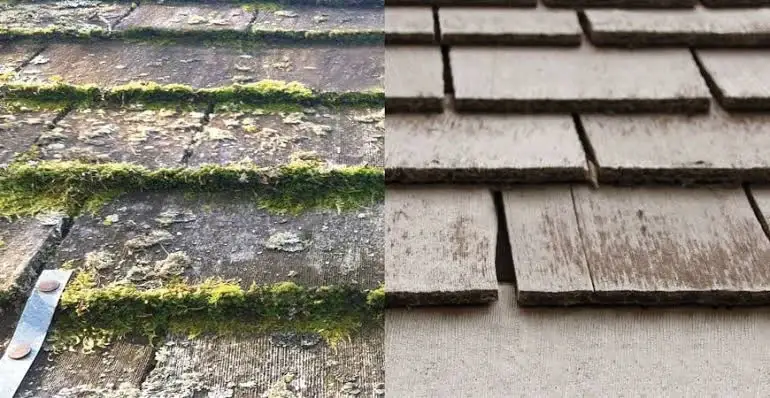
Moss stops the drying. A cushion sitting on a shake keeps the wood damp right through the wet months and often into May. Wood that stays wet softens, and soft cedar is where rot fungi get started. Repeated soaking and drying also makes shakes cup, curl and split along the grain. A roof that might have had years left in it can be worn out early by a long run of wet winters under a moss cushion.
The keyways and the butts
Between every two shakes in a course is a narrow gap called a keyway. It is shaded on both sides and slow to dry, and it is where moss takes hold first. By the time growth shows across the face of a roof, the keyways underneath have usually been packed for years.
Needles from overhanging firs and cedars wash down into those same gaps and build up against the butt of the course below. That is why the bottom edge of each course is usually the first part to go soft. Cleaning only the faces and leaving the keyways full leaves the worst of the moss in place.
How it works
Getting Your Roof Moss Removal Booked
Simple from start to finish. Tell us about your roof, get a straightforward quote, and let us do the climbing.
Tell us about your roof
A few details are all we need.
Send us your address, the number of storeys, what the roof is made of if you know, and how much moss you can see from the ground—plus any trees hanging over it.
Get your quote
We price your roof, not a generic house.
Pitch, height, roofing material, how thick the moss is and how we get up there all matter. You'll have a clear quote before we start.
We clear the roof
You stay on the ground.
We lift the moss off by hand, brush the courses clean, treat the roof where it helps, and bag the moss and take it with us. Any washing is a low-pressure soft wash, and high pressure never touches your shingles.
You know what we found
We'll let you know if we spot something.
Lifted shingles? A cracked shake? Worn granules or tired flashing? We'll give you a straightforward heads-up.
That's it.
- You tell us about the roof.
- We give you a clear quote.
- We take the moss off.
- You get one less chore to worry about.
Ready to get the moss off your roof? Get your quote and let us do the climbing.
How we work on shakes
Before anyone climbs up, we look at each slope from a ladder at the eave. Shakes that are split, cupped, loose or dark and spongy at the butt are noted, and we plan a route that keeps our weight on sound wood. Weathered cedar can be slick when damp and brittle when bone dry, so we choose the conditions as much as the date.
Moss comes off the faces with soft brushes and plastic scrapers moving down the slope and along the grain. Working across the grain tears the fibres and leaves a fuzzy surface that holds water. The keyways are cleared by hand, one at a time, with narrow plastic tools that do not pry at the shakes on either side. It is slow, and on a big roof that is where most of the hours go.
High-pressure washing is not part of it. It shreds the soft surface wood and pushes water into the joints. What growth remains in the grain is treated and left to die back over the following months. The rest of the visit, from covering garden beds to raking up what falls, follows our usual roof demossing routine.
What we tell you at the end
You get a list of the shakes that worried us: which slope, where on it, and why. Soft butts across a whole slope usually mean the roof is near the end of its life, whatever the moss was doing. A handful of split or missing shakes is a small repair for a roofer.
To slow the moss down between visits, see our moss treatment and prevention page, which covers zinc strips and branch clearance. Comparing materials? Our asphalt shingle page explains why that roof is handled differently. When you are ready, ask us for a quote.
Why choose us
Why choose us for cedar shake roofs
Patience on old wood
A shake roof takes longer than asphalt of the same size. We quote for that time instead of rushing the slopes.
We know where not to step
Soft butts, split shakes and old patches are mapped before we put weight on the roof.
Plain advice on condition
If the shakes are past saving, we say so, so you can decide whether demossing is still worth it.
Covered and accountable
We carry insurance and WCB registration, and if a slope is not left the way we agreed, we come back to finish it.
Got questions?
Cedar shake moss questions
Is a high-pressure wash ever safe on cedar shakes?
Not in our view. Even moderate pressure strips the weathered surface and raises the grain, and the roughened wood then holds more water and grows moss back faster.
It also forces water up into the gaps between courses, which is the last place a cedar roof needs it.
Can you tell me if my shakes are rotten?
We can tell you which ones feel soft underfoot or under a thumb, which are split through, and which have cupped or come loose. Those observations come from being on the roof.
Whether the roof needs repair or replacement is a question for a roofer, and we will suggest you call one if what we find points that way.
Will my roof look new once the moss is off?
No. It will look like clean, weathered cedar, which is usually silver-grey. Some dark staining in the wood stays, and a light film of treated growth fades over the following months.
If you want the overall surface washed of lichen and algae as well, our roof cleaning page explains how that is done gently.
How often should a shake roof be done?
A shake roof under fir or cedar trees often needs attention every two to three years. One on an open, sunny lot can go a good deal longer.
Catching it while the growth is thin means less work in the keyways and less time with the wood held wet.
Do you replace broken shakes?
No. We are a moss removal crew, not roofers. We show you where the damaged shakes are so a roofer can quote the repair, ideally before the next run of fall storms.
My shakes have been treated with a preservative. Does that change anything?
Tell us when you book and roughly when it was applied. It does not change how we remove the moss, but it helps us judge how the wood has aged and what follow-up makes sense.
Cedar Shake Roofs in Nanaimo and the mid-Island
Tell us the address and we will get you a price.